Interior Design Budget by Style: What $30k, $50k & $80k Gets You in Singapore
Every renovation guide you see online starts with the flat or the style.
This one is different. It starts with the check, because we know real decisions are made based on the budget. You know roughly what you have. What you do not know is which of these styles still looks like itself at the budget you have, and which one quietly turns into an approximation of itself.
If you have a renovation budget of $30,000, $50,000, or $80,000, the first question is usually which style you can afford. Instead, you need to ask how much it will cost to customise the house to your liking.
A budget does not buy a style on its own. It buys a certain amount of renovation work, materials, carpentry, and detailing. The style you choose affects how that money gets used.
A $50,000 renovation with simple finishes and controlled carpentry can look very different from a $50,000 renovation built around stone, detailed joinery, and a heavily customised kitchen.
So instead of asking about low budget small house interior design, it is more useful to ask: what can this budget actually accomplish, and where will you have to compromise?
Budget Friendly Home Interior Design — First, Decide What You Want To Do
A 4-room BTO and a 4-room resale can have the same number of rooms but very different renovation requirements. Hence, naturally, they also have different renovation budgets. What most people don’t realise is that renovating a resale can at times cost more than designing a BTO.
A newer BTO generally gives you a cleaner starting point, with items such as wet-area finishes, sanitary fittings, doors and existing electrical provisions already in place.
A resale flat may need some of those things removed, repaired or replaced before the new design can begin. Demolition and disposal, flooring work, bathroom works, electrical upgrades and repairs all come out of the same renovation budget.
Over our years of designing and renovating homes around Singapore, we have found that most people don’t struggle to define a budget; they struggle to stick to it.
One of our published 4-room projects came in at around $58,000 without hacking. The owner put the budget into a premium kitchen, built-in wardrobes and upgraded flooring, then kept the scope under control once the design was approved.
The lesson that we learned during this project was that home renovation budgets are less about the exact $58,000 figure and more about what happened to the money:
When you ensure that the budget goes into a defined scope rather than being spread across unnecessary changes, the process becomes streamlined.
You can find the project and its cost breakdown in our HDB renovation cost guide.
So treat the figures in this article as planning ranges, not fixed prices. A BTO may leave more of the budget for finishes and carpentry. A resale flat may need part of that budget simply to get the existing space ready.
What Changes The Renovation Budget More Than The Style Name?
Before comparing Scandinavian with Japandi or industrial, look at the things that actually move a renovation quote.
- Flat size: A 3-room and a 5-room naturally require different amounts of flooring, painting, lighting, and carpentry.
- Existing condition: A well-kept resale can require much less preliminary work than one that needs extensive removal or replacement.
- Hacking: Removing walls, flooring, or existing fittings adds demolition and disposal costs before the new work starts.
- Kitchen specification: Cabinet volume, countertop material, hardware and appliances can move the budget quickly.
- Bathrooms: Waterproofing, tiling, sanitary fittings and hacking can make bathrooms one of the more expensive parts of a renovation.
- Carpentry: Wardrobes, TV storage, kitchen cabinets and full-height storage can consume a large part of the budget.
- Materials: Laminate, veneer, stone-look surfaces, natural stone and other finishes can sit at very different price points.
How much of the flat you renovate: This is often the biggest decision of all. That last point is why the same style can appear at very different budgets.
$30,000: buy one style properly, or one room group properly
$30,000 is a workable renovation budget, but it is not enough for a full revamp in a typical 4-room flat.
This is where scope matters most.
As per research data from this moodboard, a whole 3-room Scandinavian renovation starts at around $30,000 at the lower end, while modern minimalist renovations start from around $20,000. A partial renovation covering areas such as the kitchen and living room is priced at around $25,000–$45,000.
That gives you several realistic ways to use $30,000.
What you need to do is plan the renovation a little more comprehensively. And there are a few ways to do that.
For starters, you could just concentrate on the kitchen and living areas. Or you could keep the existing parts of the flat that are still serviceable and put the money into the rooms that need the most work.
What you should not expect is a full 4-room renovation with extensive hacking, multiple bathrooms, large amounts of custom carpentry and premium finishes all competing for the same $30,000.
The better approach is being selective. And that is exactly what we did during the renovation of Classic Elegance. When the client came to us, they said one thing: I have a limited budget, but I need my house to look good.
So, we got to work.
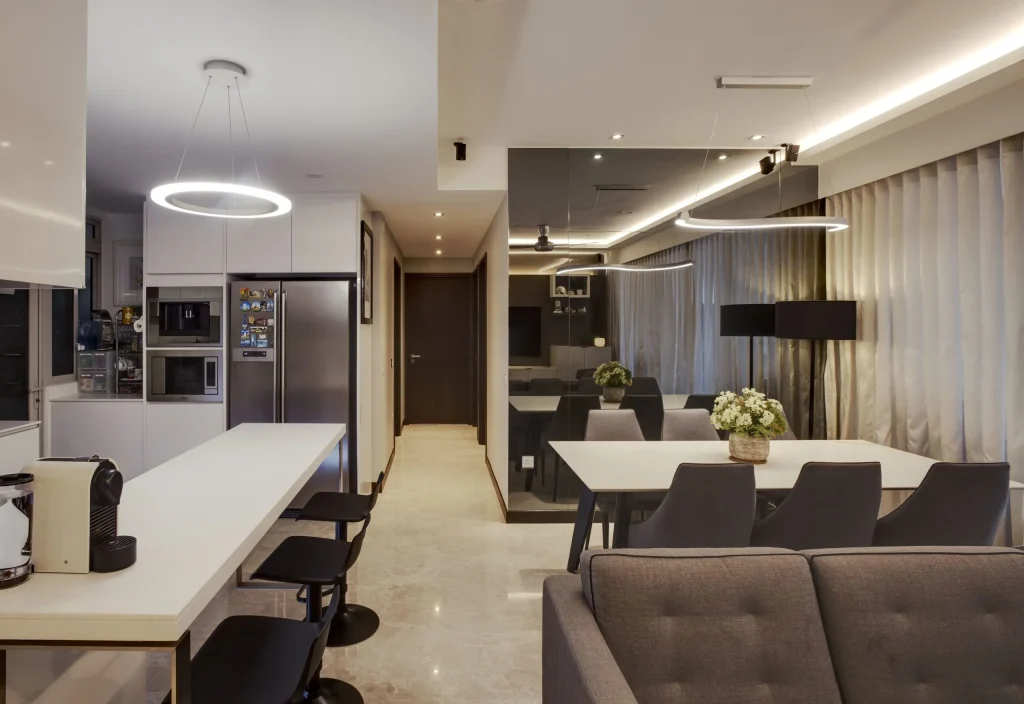
In the living room, we just repainted, improved the lighting, and built one useful storage run instead of filling the room with cabinetry. This is one of the simple budget interior design living room ideas that you can easily adopt.
In a bedroom, one well-made wardrobe may make more sense than a complete built-in suite.
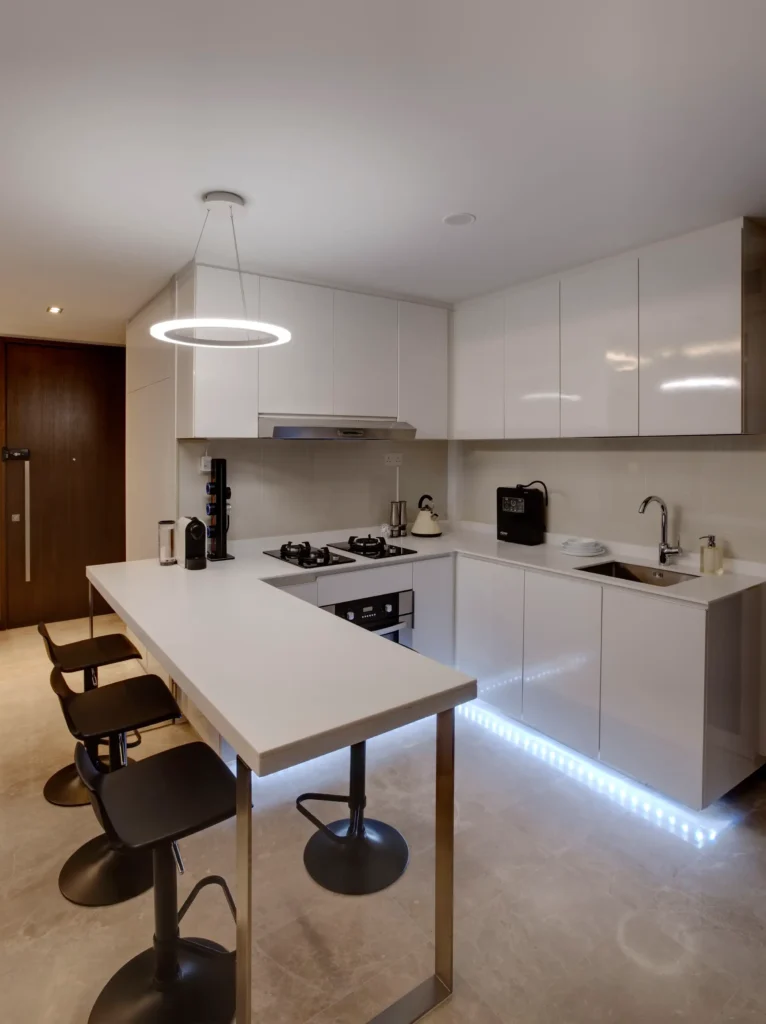
The existing kitchen was still usable, so we just made minor changes to make it fit the theme of the house.
The styles that lend themselves naturally to this approach are Scandinavian and modern minimalist because their visual language can be achieved without relying on a large number of decorative or highly specialised finishes.
That does not mean either style is inherently cheap. It means a restrained design gives you more freedom to decide where not to spend. The house we discussed earlier is a perfect example of this principle: the 3-room home puts the emphasis on function and finish rather than trying to maximise the amount of built-in carpentry.
The important distinction at $30,000 is not cheap versus expensive style. It is complete renovation versus selective redesigning.
$50,000: The Band Most People Land In, And The One That Hides Its Costs
The good news is that $50,000 can get you a lot of style ranges:
- Scandinavian: $30,000–$55,000
- Modern minimalist: $35,000–$60,000
- Japandi: $40,000–$70,000
- Industrial: $45,000–$80,000
But that does not mean $50,000 buys the same renovation in each style. It just means the budget is now large enough that the decisions within the style become more important.
| Style at $50k | On a 4-room BTO | On a 4-room resale |
| Scandinavian | Comfortably mid-tier, room to spare | Complete and calm |
| Modern minimalist | Mid-tier: full-height wardrobes, integrated storage | Mid-tier, or basic with a better kitchen |
| Japandi | Mid-tier: custom carpentry, oak veneer | Bottom of mid-tier; watch the timber spend |
| Industrial | Entry of its range — workable, not generous | Tight. Expect to drop a room |
These are planning examples, not fixed packages. The actual scope depends on the flat and the specifications.
Carpentry is one reason the budget can disappear quickly. We have observed that carpentry takes around 30–40% of a typical renovation budget, with kitchen cabinetry at approximately $8,000–$20,000 and wardrobes at around $3,000–$8,000 each.
That is why the question at $50,000 should not simply be “Which style can I afford?”
It should be:
How much carpentry do I actually need to make the style work?
A floor-to-ceiling storage wall, concealed door, and integrated storage can make a minimalist interior look effortless, but the effort is in the construction.
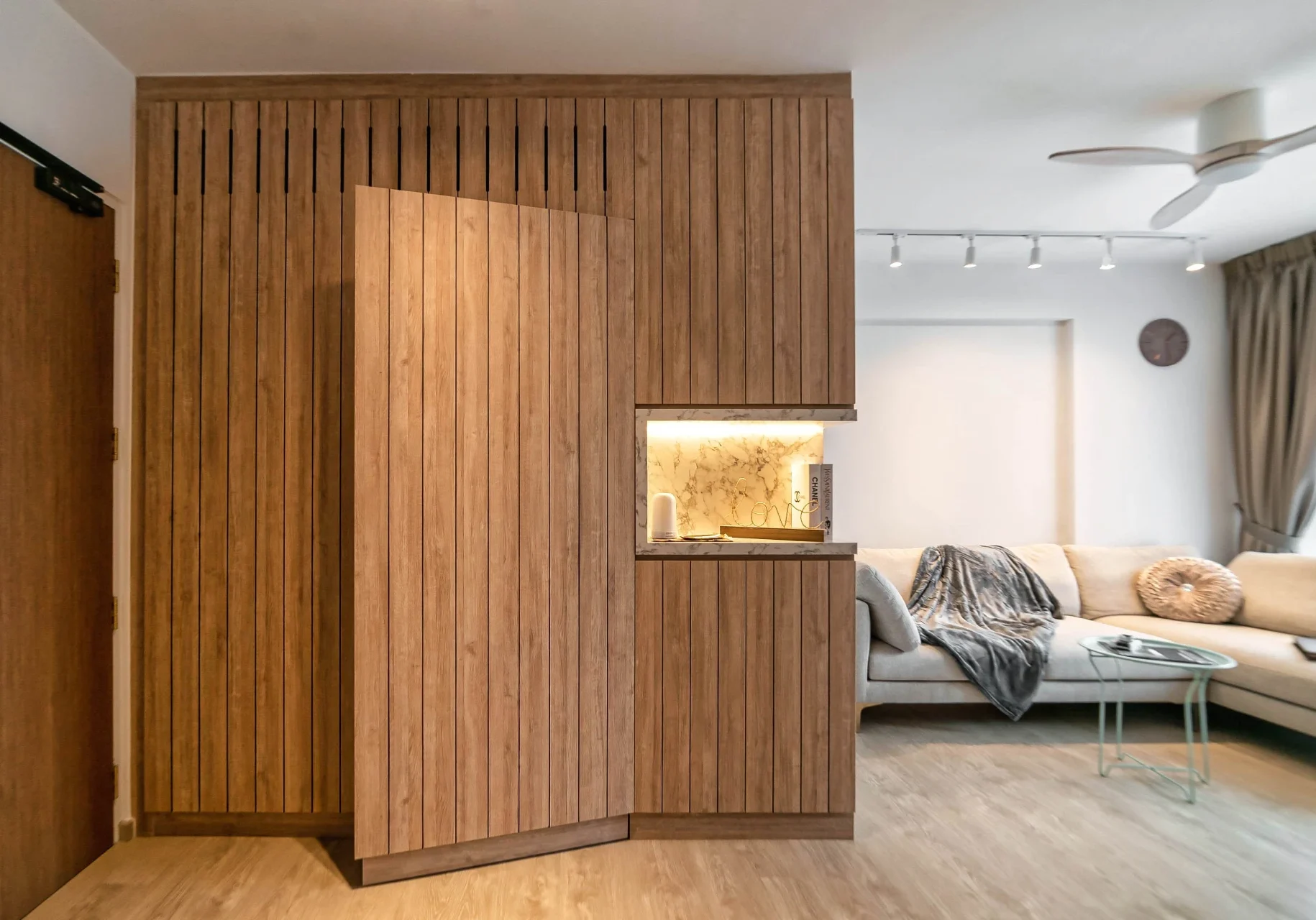
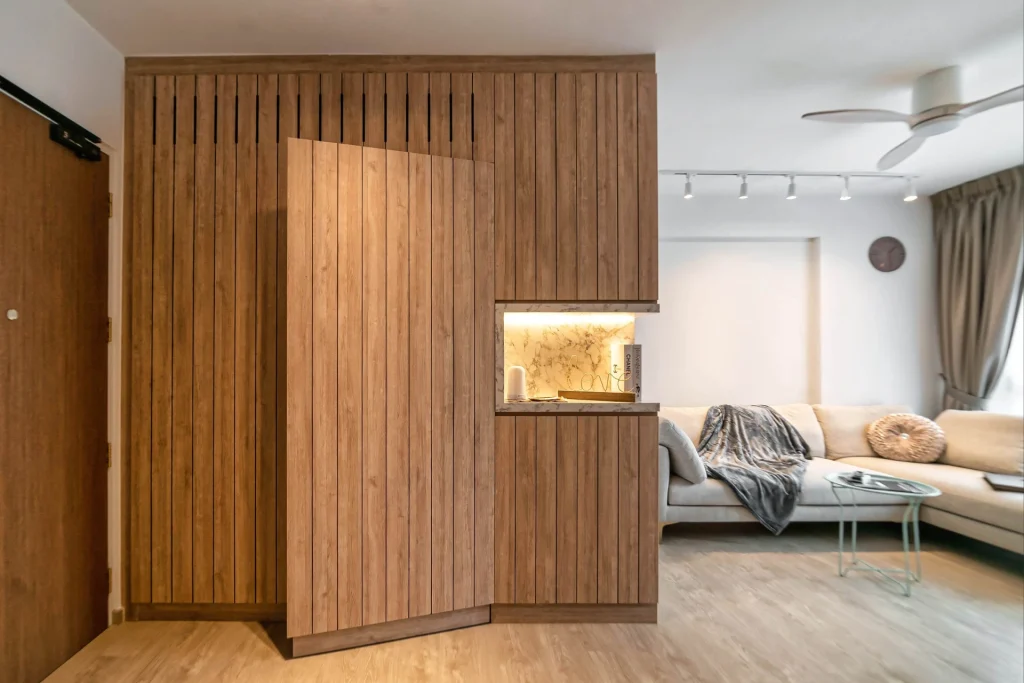
Our 874D Tampines project is a good point of reference. The cabinetry runs from floor to ceiling and incorporates a concealed door. It is visually quiet, but that quietness comes from careful joinery.
The same principle applies to Scandinavian interiors.
At 138D Yuan Ching Road, the dining bench doubles as concealed storage. That is a useful design decision because it adds capacity without requiring another separate cabinet run.
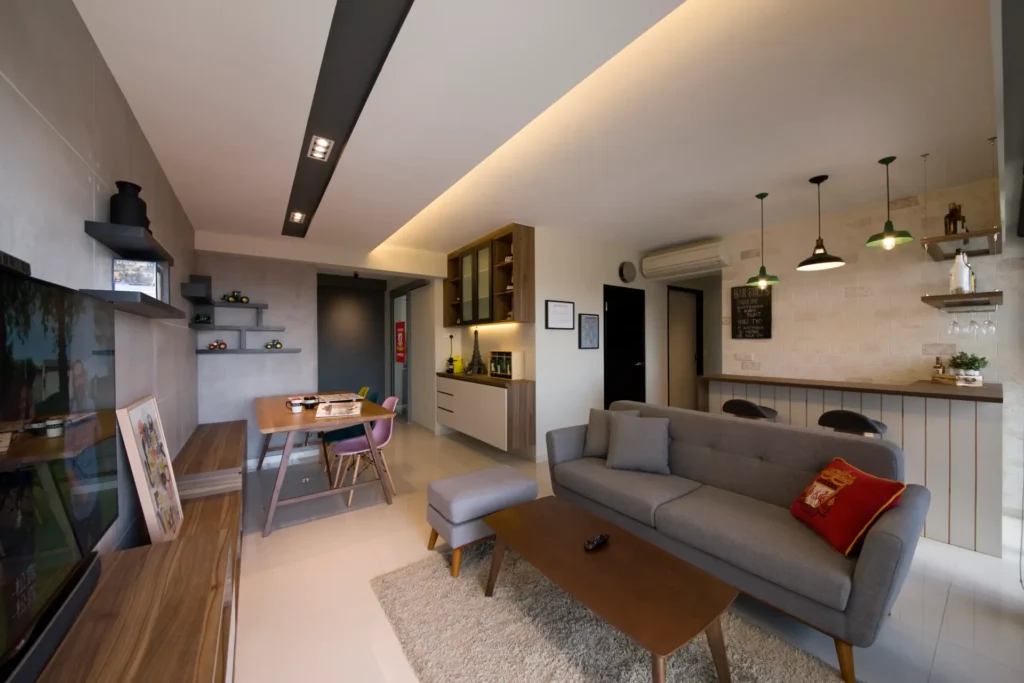
At this budget, two relatively unglamorous decisions can also make a major difference:
Keep flooring that is still good enough to live with.
Do not hack simply because the new design could look different without it.
Every dollar you do not spend removing something is a dollar available for something you actually need.
$80,000: depth of finish, or more of the flat
At $80,000, the renovation scope changes again.
You have enough room to consider higher-specification finishes, more detailed carpentry and a more comprehensive renovation. But that does not mean you should automatically upgrade everything.
You still have a choice between depth and coverage.
A 4-room flat could use the budget to go deeper into the details: better surfaces, more refined joinery, a more comprehensive lighting plan and properly resolved bathrooms.
Similarly, a 5-room flat could use the same budget more broadly, bringing more rooms to a good, consistent standard rather than concentrating the entire budget on a few showcase spaces.
Trying to do both is where you start to lose control over the budget.
The style itself is not what makes the $80,000 renovation expensive. It is the amount of customisation and specification you attach to it.
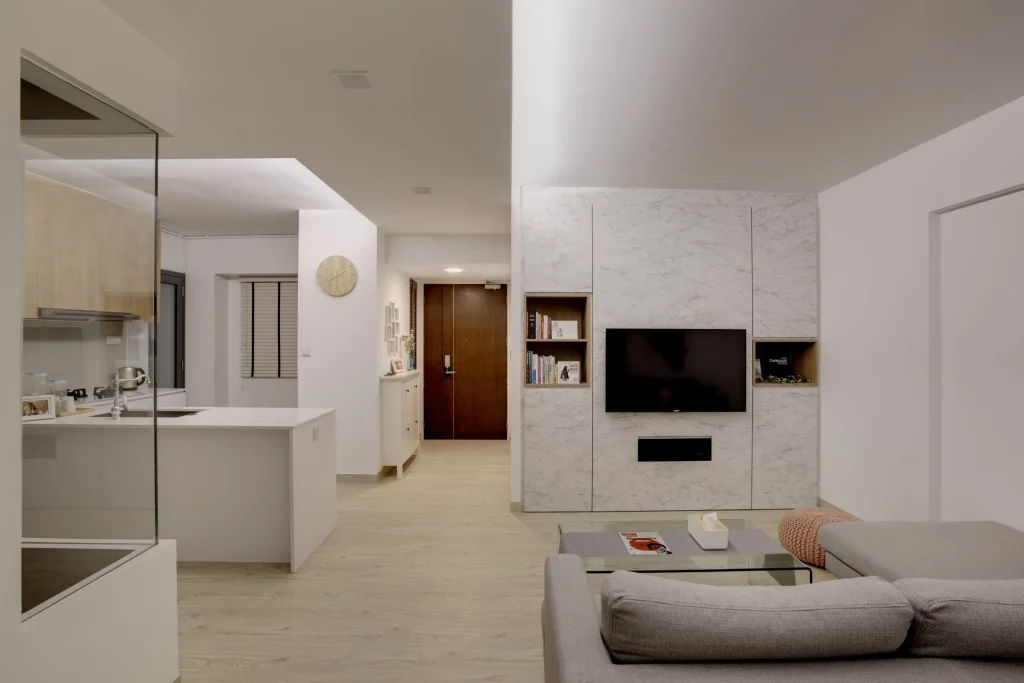
Our 1G Cantonment Road project uses a restrained palette, pale continuous flooring, closed joinery and a marble-look feature wall. The effect comes from keeping the number of visual elements controlled rather than filling the room with decoration.
Industrial interiors can also make more sense at the upper end of their published range because there is more room for material and detailing choices.
At 440A Fernvale Link, the industrial scheme is not simply black cabinetry and exposed-looking finishes. Cement grey walls, timber slat blinds and light oak units soften the overall palette.
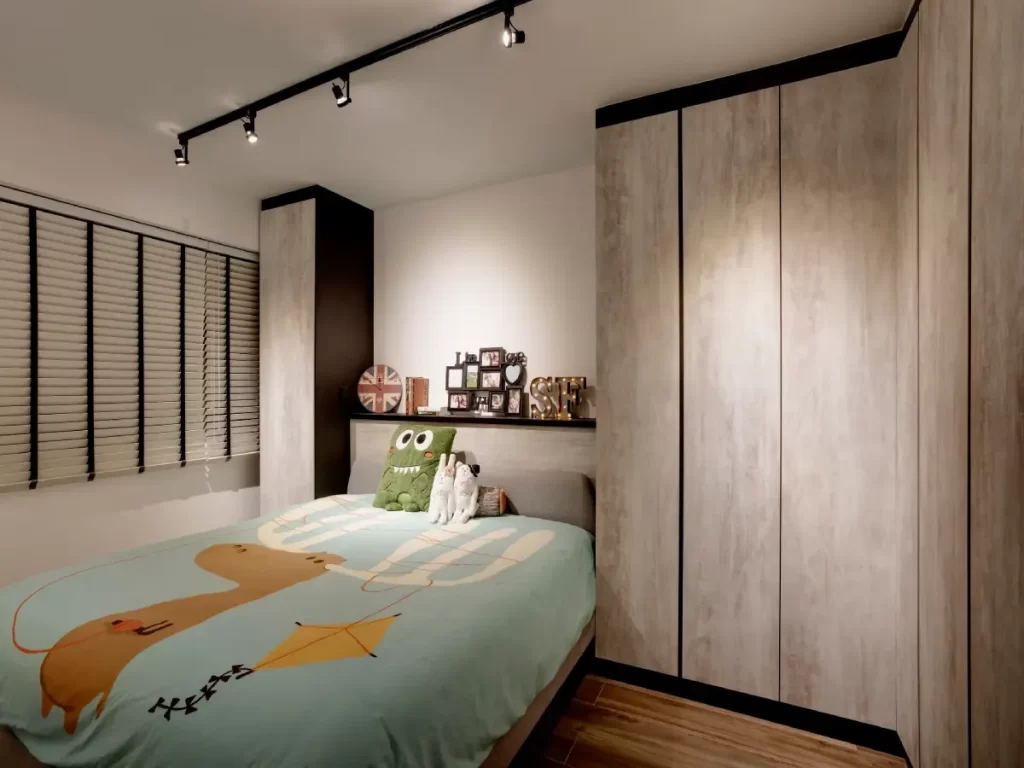
That is an important distinction: a style does not become more convincing simply because more money is spent on it. The money needs to go into the parts that define the design.
At $80,000, you may be able to create a luxury-leaning home, but the scope still needs to be controlled. A quieter design executed consistently can sometimes make better use of the same budget than an expensive-looking scheme spread too thinly.
So, What Does $30k, $50k Or $80k Actually Buy?
At $30,000, think selective. A smaller flat can be renovated more comprehensively, while a 4-room flat will usually require harder choices about which rooms and finishes to prioritise.
At $50,000, a 4-room renovation has more room to feel complete, but carpentry and material choices still need to be controlled. This is where Scandinavian, minimalist, Japandi and even industrial schemes can overlap, depending on scope.
At $80,000, you have more freedom to specify materials, detailing and carpentry, or to spread the budget across a larger home. The decision becomes whether you want to renovate more of the flat or go deeper into fewer spaces.
And that is ultimately the point.
There is no universal “$50k style”.
There is only a $50k budget being divided between the existing condition of the flat, the rooms you choose to renovate, the amount of carpentry you need, the materials you select, and the level of detail you want.
Choose those first.
The style will follow.
Planning A Renovation Around Your Budget?
If you already know roughly what you want to spend, the useful next step is to work backwards from the scope rather than choosing a style first.
Bring your floor plan, your budget, and the parts of the home you know you want to change. We can help you work through what that budget can realistically achieve, where to spend more, and where leaving something alone makes more sense.
Book a consultation with This Moodboard to start planning your renovation.